Establishing a cohesive Autonomous Smart City dashboard resolves critical administrative bottlenecks instantly.
The adoption of a comprehensive Autonomous Smart City architecture has escalated from a futuristic concept into an absolute prerequisite for metropolitan survival. A modern metropolis generates tens of quintillions of datapoints every single second, effectively transforming the very air into mathematical static.
Therefore, relying on fragmented departmental software and human-speed administration to govern this rapidly expanding urban sprawl is entirely a recipe for administrative collapse.

The Trap of Isolated Data Silos
Currently, municipal police forces utilize one isolated dashboard to monitor highway congestions, energy departments use antiquated SCADA systems for sub-stations, and civil waste sectors stare at static spreadsheets. This absolute isolation ensures that a catastrophic failure in one department aggressively collapses another without the slightest digital warning.
A one-minute delay in data exchange across departments can lead to paralyzed economic intersections.
Orchestrating an Autonomous Nervous System
Our masterplan completely obliterates these fragmented barriers by establishing an Autonomous Smart City integrated neural interface. This command center aggressively devours all municipal APIs simultaneously into a single pane of glass.
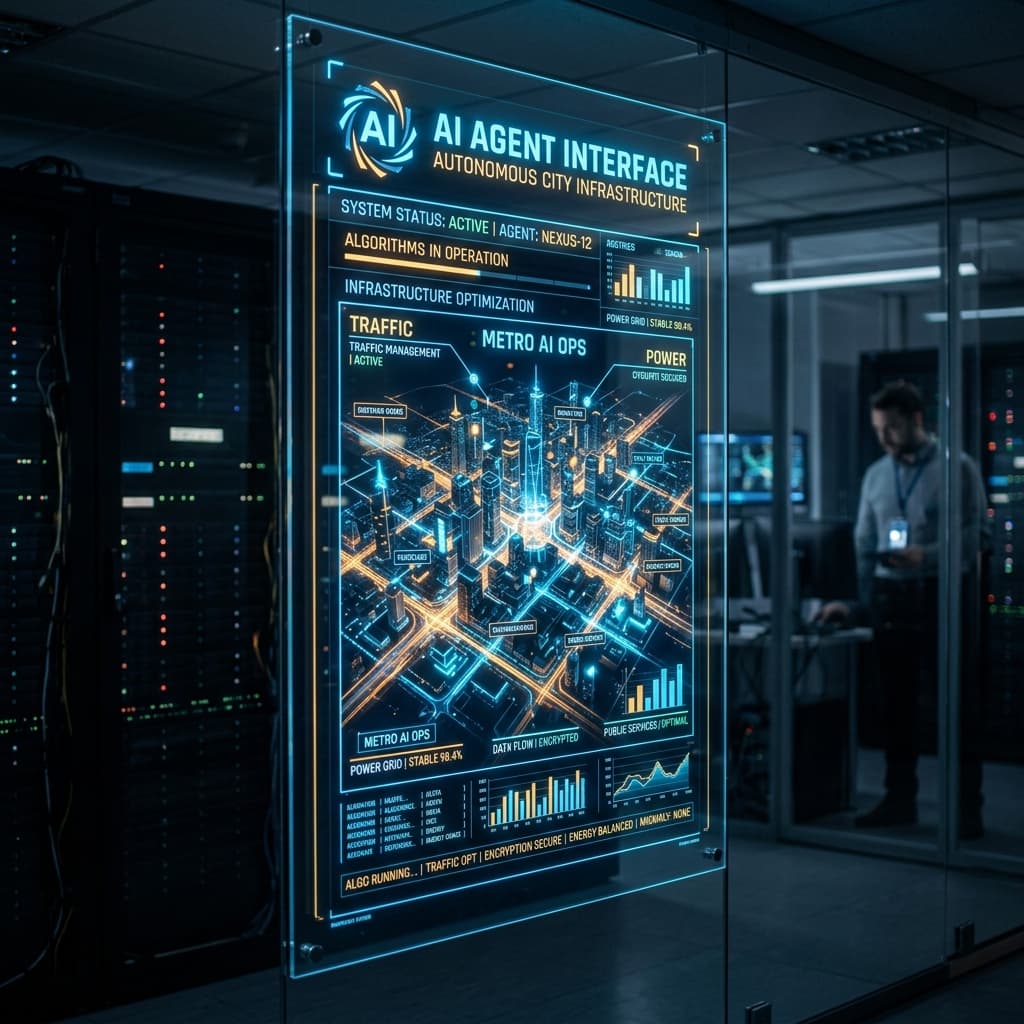
By pushing this chaotic mass of information through DEMA DIGITAL ASIA's centralized Big Data backbone, thousands of traffic camera feeds are instantaneously scrubbed by computer vision models. Consequently, the AI overrides manual traffic light schedules, dynamically adapting red-light durations perfectly based on localized vehicle queue density in real time, virtually extinguishing traffic black-spots before they manifest.
Governing by Absolute Logic
The sheer scope of an Autonomous Smart City extends far beyond pavement control and traffic light manipulation.

Municipal waste bins equipped with deep-scanning ultrasonic weigh-sensors autonomously dispatch routing tickets to automated garbage trucks right at the exact nanosecond they cross 85% capacity thresholds. Urban power grids predict energy spikes hours in advance, rerouting power from dormant financial districts to active residential blocks seamlessly.
In conclusion, the mayor’s office is no longer repeatedly bogged down by delayed citizen complaints. The city breathes, corrects, and heals itself continuously, establishing a predictive mathematical symphony orchestrated by flawless machine logic.
Strategic Implementation and Corporate Integration
To successfully adopt this paradigm shift, enterprise leaders must transition from legacy mindsets to agile digital transformation frameworks. The implementation requires cross-departmental synergy, heavily involving the Chief Information Officer (CIO) and Chief Information Security Officer (CISO). A phased rollout strategy mitigates operational risks while ensuring that employees have adequate time to adapt to new technological interfaces.
Measuring ROI and Key Performance Indicators (KPIs)
Investing in cutting-edge enterprise technology is only justifiable if it delivers a measurable Return on Investment (ROI). Executives must establish clear Key Performance Indicators (KPIs) before deployment. These metrics often include the reduction in mean time to repair (MTTR), improvements in customer satisfaction scores (CSAT), and the overall decrease in operational overhead costs. Continuous monitoring via real-time analytics dashboards is essential to guarantee that the technology aligns with quarterly financial objectives.
The Role of Cloud Computing infrastructure
None of these advancements are possible without a robust, highly available cloud computing infrastructure. Migrating core workloads to multi-tenant cloud environments (such as AWS, Google Cloud, or Azure) provides the infinite scalability required to process vast amounts of telemetry data. Furthermore, utilizing edge computing networks drastically reduces latency, allowing AI models to execute mission-critical decisions in milliseconds rather than relying on distant centralized servers.
Future Outlook: 2026 and Beyond
As we look towards the end of the decade, the convergence of Artificial Intelligence, Quantum Computing, and robust Cybersecurity will blur the lines between digital and physical enterprise assets. Companies that proactively embrace these disruptive technologies today will establish an insurmountable competitive moat. Conversely, organizations that cling to outdated legacy processes will face rapid market obsolescence in an increasingly ruthless global economy.
Enterprise Solution Architecture
To execute these technological initiatives flawlessly, relying on internal IT teams is rarely sufficient. Global conglomerates are aggressively outsourcing to specialized Cloud Migration Services to ensure a zero-downtime transition of their legacy monolithic databases. Concurrently, deploying robust Enterprise Cybersecurity Solutions acts as the definitive shield against sophisticated nation-state threat actors attempting to exploit the migration phase.
For backend administrative efficiency, partnering with top-tier agencies for RPA Software Implementation is critical to automating financial and HR workflows. Furthermore, leveraging B2B Big Data Analytics enables the C-Suite to extract actionable intelligence from supply chain telemetry, while seamless ERP Integration guarantees that every department operates from a single source of truth.